

Navigating Attorney Fee Reimbursement in Federal Employment Cases: What Every Client Needs to Know

Learn how attorney fee reimbursement works in EEOC cases, MSPB appeals, and federal employment litigation, including prevailing-party requirements, fee calculations, and common reasons fee awards are reduced.
By Kevin Crayon II, Esq.
You've Won Your Case, Now What?

This article is for plaintiffs, complainants, and appellants, with a focus on employees pursuing legal action against their employers. It is a roadmap for those who have successfully navigated the legal landscape and are now prepared to share their hard-won victories. Winning your case is a major victory, but it does not automatically mean the employer or agency will reimburse all of your attorney fees.
The Big Myth About Attorney Fees

Many federal employees assume that if they win their Equal Employment Opportunity (EEO) case or Merit Systems Protection Board (MSPB) appeal, the agency will automatically write a blank check to reimburse every dollar spent on legal representation. This is a common misconception.
While fee reimbursement is a powerful tool in federal-sector employment litigation, it is not automatic, and it is rarely a dollar-for-dollar refund. The strongest fee recoveries come from strategic litigation, where an attorney and client partner to focus on the strongest claims rather than taking a "scattershot" approach.
The Foundation: How Are Fees Calculated?

When federal tribunals award attorney fees, they generally use a mathematical formula known as the "Lodestar" method: Reasonable Hours Expended multiplied by a Reasonable Hourly Rate.
To prove an hourly rate is reasonable, attorneys must show it aligns with the "prevailing market rate" in the specific community where the litigation takes place. Federal judges and administrative judges require extensive proof for this, which often includes sworn declarations from local peer attorneys, such as obtaining an affidavit from an Atlanta employment lawyer to justify an Atlanta-based rate. Attorneys also point to established fee guidelines, such as the Laffey or Fitzpatrick Matrix, to show their rates are below or at market value.
Because employment cases often take years to resolve, attorneys may use different hourly rates at different stages of litigation as their experience and market rates increase.
Different Venues, Different Rules

To even request attorney fees, you must understand that the rules change dramatically depending on the venue:
Federal Civil Actions
In federal court, the right to request fees is triggered when the plaintiff is formally determined to be a "prevailing party." This usually requires obtaining a favorable jury verdict or court judgment. Plaintiffs can also seek recovery for out-of-pocket litigation expenses (like travel lodging and FedEx costs) as well as specific statutory court costs.
The EEOC
If an EEOC Administrative Judge issues a decision finding discrimination, the clock starts ticking immediately to recover damages and remedies. Judges typically issue an order setting a strict deadline, often just 30 days, for the attorney to submit a verified statement of fees and costs. If this strict deadline is missed, the right to recover any attorney fees is completely waived. Additionally, if an EEOC client wins a large lump-sum backpay award that pushes them into a higher tax bracket, they can petition the agency to cover their increased federal income tax liability.
The MSPB

The MSPB is the strictest venue and is governed by regulations. Simply "prevailing" is not enough; the employee must also prove that a fee award is warranted in the "Interest of Justice." This "interest of justice" requirement makes MSPB fee awards more difficult to obtain than many employees realize.
Judges rely on the "Allen Factors" to determine this. For example, in one of the firm's MSPB cases, fees were awarded because the attorney successfully proved the agency "knew or should have known" it would not prevail on the merits, having fired the employee for an incident while ignoring a comparator who engaged in the exact same conduct.
The Danger of the "Scattershot" Approach

When a client feels wronged, the natural instinct is to throw every possible claim at the wall to see what sticks. Strategically, this can significantly reduce fee recovery.
If you bring multiple, unrelated claims but only win on one, tribunals will heavily reduce your attorney fee award. In one of the firm's EEOC cases, for example, the judge slashed the attorney's pre-summary judgment fees by 30% and post-summary judgment fees by 10% because time was spent pursuing claims that were ultimately unsuccessful.
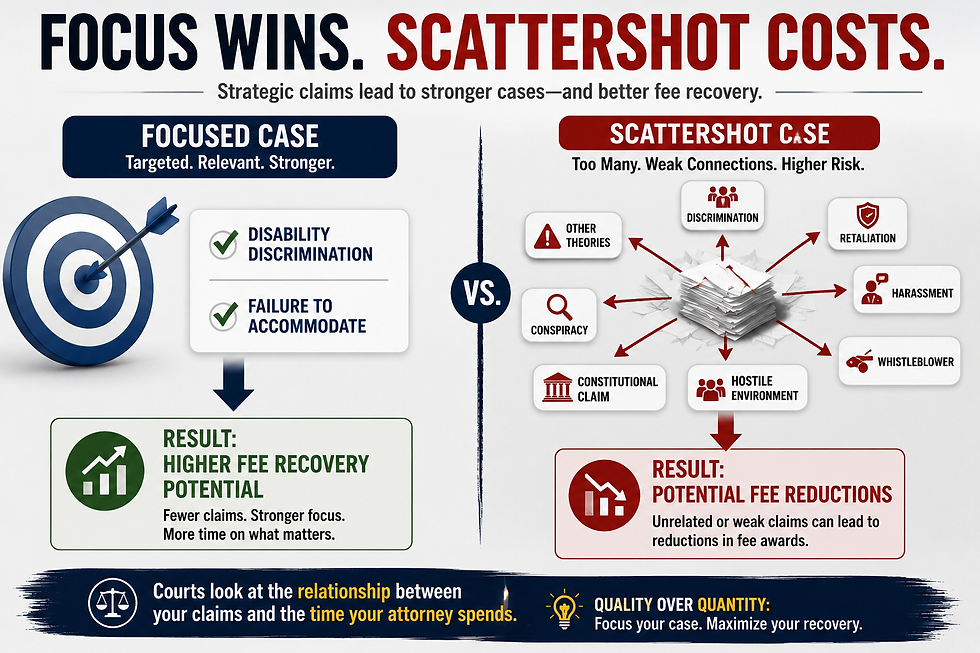
However, if your claims share a "common core of facts," you are in a much stronger position. In one of the firm's MSPB cases, the agency tried to cut the attorney's hours because the client didn't win every single affirmative defense. The judge rejected this reduction, ruling that because the core relief was achieved (reversing the removal) and the claims were intertwined, the attorney was entitled to a fully compensatory fee with no reductions. **The lesson: Quality and focus always beat quantity.**
"Billing Judgment": Why Efficiency Matters
Federal judges scrutinize billing records line by line. To win fees, attorneys must demonstrate "good billing judgment" by voluntarily excluding excessive, redundant, or purely clerical time. Lawyers build credibility with judges by preemptively dropping unrecoverable costs (like dropping a $100 medical record fee when medical expenses aren't awarded) or explicitly waiving fees for pro bono efforts (such as waiving 9.6 hours of work worth over $2,800 to help an MSPB client post-representation). For example, while tracking deadlines is important, the act of merely transferring dates into a paper calendar may be considered "purely clerical" overhead and may be excluded from a fee award.

When attorneys fail to exercise this restraint, the penalties are severe. In one of the firm's cases, a separate law firm handled the client's damages petition (after our firm won the case) and billed roughly 12 hours to draft a 9-page motion that achieved limited success. The judge determined the time billed by the separate law firm was excessive.
The Bottom Line
Attorney fee reimbursement can be one of the most valuable remedies available in employment litigation, but it is never automatic. Courts, administrative judges, and agencies expect fee requests to be reasonable, well-documented, and tied to successful claims. The strongest fee recoveries typically result from focused litigation strategies rather than pursuing every possible grievance.
Good legal representation is a strategic partnership. It requires discipline to identify the strongest legal path and the judgment to avoid unnecessary, time-consuming disputes. By focusing resources on your strongest claims, you and your attorney maximize the likelihood of success while improving the chances of recovering attorney fees and litigation costs.
Comments